Last updated: March 7, 2026
Two months after U.S. special forces captured Nicolás Maduro in a pre-dawn raid on Caracas, Venezuela remains suspended between transformation and continuity. The country's interim leader, Delcy Rodríguez, is opening the oil and mining sectors to American multinationals at a pace that has stunned analysts. Washington is sending cabinet secretaries to Caracas. Political prisoners are being released. And yet, the Chavista state apparatus — its military, its judiciary, its intelligence services — remains fundamentally intact.
This is the story of the most consequential U.S. intervention in Latin America since the Cold War, and the deeply uncertain chapter that follows it.
How Maduro Was Captured: Operation Absolute Resolve
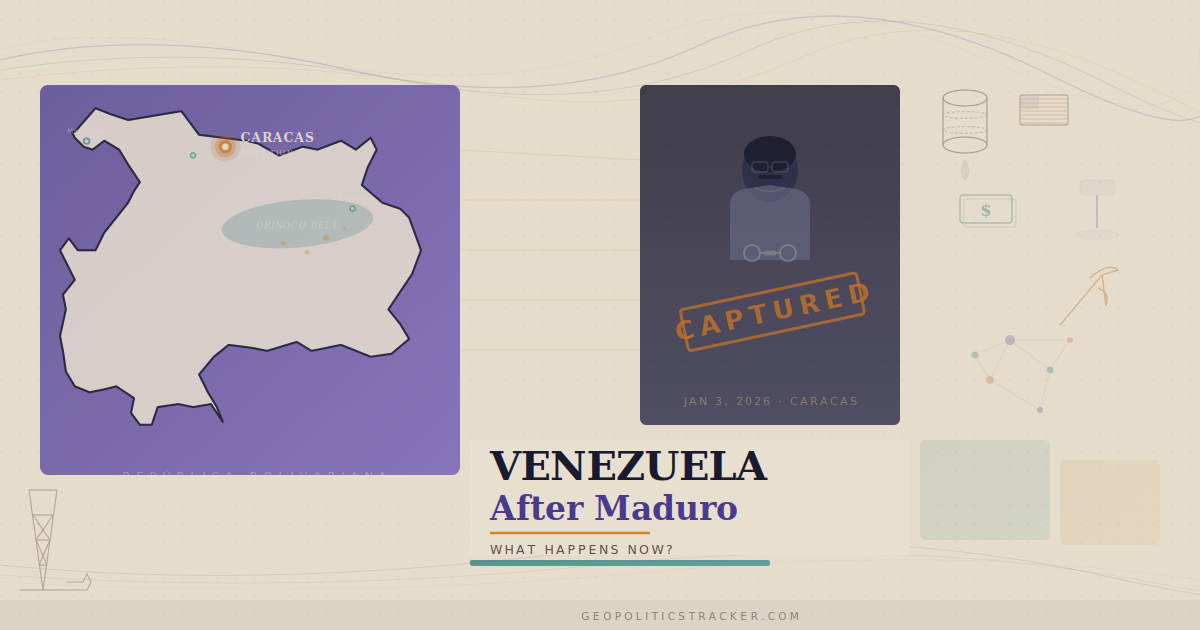
On January 3, 2026, the United States launched Operation Absolute Resolve, a large-scale military strike targeting multiple Venezuelan states. The operation, carried out primarily by Delta Force operatives with CIA ground intelligence, struck infrastructure across northern Venezuela to suppress air defenses before an apprehension team attacked Maduro's compound at Fort Tiuna in Caracas. Maduro and his wife, Cilia Flores, were extracted and flown to the USS Iwo Jima, then onward to New York, where they were arraigned in Manhattan federal court on charges of narco-terrorism, cocaine importation conspiracy, and possession of machine guns and destructive devices. Both pleaded not guilty. Before entering his plea, Maduro declared himself a prisoner of war.
The Trump administration justified the operation as a law enforcement action supported by military force, citing the president's "inherent constitutional authority." The New York Times editorial board condemned it as dangerous and lacking international legitimacy, comparing it to past U.S. interventions in Libya, Afghanistan, and Nicaragua. The United Nations, the AFL-CIO, Cuba, Colombia, and Russia all condemned the raid, with Venezuela's U.N. envoy requesting an emergency Security Council meeting.
The operation had been building for months. Since mid-2025, the U.S. had maintained a massive naval presence off Venezuela's coast, striking alleged drug boats, seizing sanctioned oil tankers, and even destroying a port facility with a drone strike. A Congressional Research Service brief noted that the administration had informed Congress U.S. forces were in a "non-international armed conflict" with drug cartels in Venezuela and beyond.
Delcy Rodríguez: The Balancing Act
Within hours of Maduro's capture, Venezuela's Supreme Court declared a "forced absence" — a legal concept not explicitly defined in the Venezuelan Constitution — and ordered Vice President Delcy Rodríguez to assume acting presidential powers. Rodríguez, a long-time Chavista who served as Maduro's foreign minister and later vice president, has since moved swiftly to consolidate her position.
At a military parade in Caracas one month after taking power, General Vladimir Padrino, head of the armed forces, handed Rodríguez a sword and golden baton, symbols of the commander-in-chief role. According to NPR's reporting from Caracas, she has made at least 28 significant changes within the armed forces and reshuffled her cabinet, positioning loyalists while engaging with Washington.
Phil Gunson, an analyst cited by NPR, described Rodríguez as performing a "very difficult balancing act" between meeting reform demands from Washington and managing pressure from her own supporters — both civilian and military — who resist any political opening.
James Story, a former U.S. ambassador to Venezuela, offered a more skeptical assessment: Rodríguez's strategy, he told NPR, appears to be to do just enough to satisfy Washington while waiting to see whether U.S. attention shifts elsewhere.
Oil, Mining, and the Resource Rush
If there is one area where the post-Maduro order is moving fast, it is energy. Venezuela sits atop the world's largest proven oil reserves — 303 billion barrels, roughly 18% of the global total. Under two decades of socialist mismanagement, production collapsed from nearly 3.5 million barrels per day in the late 1990s to around 800,000 barrels today.
The Trump administration has made reopening Venezuela's oil and mining sectors its central priority:
- January 14: The U.S. Department of Energy completed its first sales of Venezuelan oil, valued at $500 million, as part of a broader $2 billion deal. According to reporting on the arrangement, Rodríguez's government has transferred at least 50 million barrels of Venezuelan oil to the Trump administration to sell.
- January 29: Rodríguez signed a sweeping hydrocarbon reform into law, giving private firms control over the sale and production of Venezuelan oil, capping government royalties at 30%, and requiring legal disputes to be resolved outside Venezuelan courts.
- February: U.S. Energy Secretary Chris Wright visited Caracas. Citgo, a U.S.-based refiner, purchased Venezuelan oil for the first time since 2019.
- March 4: U.S. Interior Secretary Doug Burgum arrived in Caracas with more than two dozen U.S. mining and minerals companies, announcing that Rodríguez would submit a mining law reform to the legislature. Shell has signed deals, Exxon Mobil has scheduled a trip, and Chevron plans to expand production.
Burgum is the fourth senior U.S. official to visit Venezuela since the raid, following Southern Command chief Francis Donovan, CIA Director John Ratcliffe, and Energy Secretary Wright. Trump praised Rodríguez on social media, writing that she is "doing a great job" and that oil was "beginning to flow."
But energy experts are tempering expectations. Jason Bordoff, founding director of Columbia University's Center on Global Energy Policy, told the World Economic Forum at Davos that while international oil companies could increase production by a third in the near term, fully rebuilding the industry would require tens of billions of dollars and many years of sustained investment.
A RAND Corporation analysis pointed to an even more fundamental constraint: the problem is governance, not geology. Meaningful recovery, RAND experts argued, would require political stability, clear legal frameworks, and confidence that the rules governing contracts would remain stable — none of which are guaranteed.
The Question of Democratic Transition
This is where the analysis gets uncomfortable. The capture of Maduro has not, by any meaningful measure, produced a democratic transition. Instead, it has produced what the International Crisis Group calls a "transaction" rather than a "transition" — a set of deals between Washington and the surviving Chavista elite focused on resource extraction, not democratic reform.
Several expert assessments paint a sobering picture:
| Source | Key Assessment |
|---|---|
| International Crisis Group | Washington's plan to "run" the country remotely while sidelining the opposition risks leaving Venezuelans worse off than before. |
| Council on Foreign Relations | If the U.S. works with regime remnants rather than elected opposition, it would perpetuate instability. Drug trafficking, mass migration, and Cuban and Iranian influence would continue. |
| RAND Corporation | Removing the leader has not changed the regime. Most of the ruling structure remains intact. |
| Stanford FSI | All the institutions of power and all the electoral offices below the president are still held by regime supporters. Prospects for democratization are limited under Rodríguez. |
| International IDEA / ConstitutionNet | Without genuine institutional reform, Maduro's authoritarian and predatory regime will persist under the new leadership. |
Venezuelan political analyst Benigno Alarcón, speaking at a forum on the Venezuelan transition on January 29, told CNN that a genuine transition requires three converging elements that are currently lacking: a new effective government, an institutional change in the rules, and decentralization of security force control. By those criteria, the transition has not begun.
The María Corina Machado Problem
Perhaps the most glaring political tension in the post-Maduro landscape is Washington's treatment of María Corina Machado, Venezuela's most popular opposition figure. Machado was banned from standing in the July 2024 presidential election, and her substitute candidate, Edmundo González, won by a landslide — a result verified internationally but denied by the Maduro regime. González has been in exile in Spain since September 2024.
During his January 3 press conference, Trump declined to back Machado, stating she "doesn't have the support" to lead Venezuela. U.S. officials at that press conference did not mention democracy, and instead emphasized contacts with Rodríguez. The Council on Foreign Relations called this "deeply worrying," arguing that if Washington deals with regime remnants instead of supporting the legitimately elected opposition, disaster would be ensured.
Dorothy Kronick, an associate professor at UC Berkeley, observed at a Stanford panel that Rodríguez has been a key regime figure for years and is clearly not a democratic activist. Harold Trinkunas, a senior researcher at Stanford's Center for International Security, noted that all institutions of power below the presidency remain in the hands of regime supporters — making a genuine democratic opening extremely difficult even if Washington pressured for one.
The Carrot and the Stick: U.S. Leverage Tactics
Behind the public praise and handshakes, Washington is wielding significant coercive power. The Trump administration's approach to Rodríguez is a carrot-and-stick operation of considerable sophistication:
The Carrots
- Unfreezing of funds related to 2019 oil sanctions
- Loosened restrictions on Venezuelan oil sales
- Public praise from Trump, lending Rodríguez domestic and international legitimacy
- Billions in potential mining and energy investment
The Sticks
- Trump warned that if Rodríguez "doesn't do what's right, she is going to pay a very big price, probably bigger than Maduro"
- Reuters reported U.S. officials are threatening a legal case against Rodríguez that could include corruption and money laundering charges (the Deputy Attorney General denied this)
- Washington is pushing for the arrest and extradition of former high-level Chavista officials
- The DEA has maintained an extensive intelligence file on Rodríguez since 2018 and designated her a "priority target" in 2022
- A continued massive U.S. military presence offshore
U.S. Secretary of State Marco Rubio has been explicit about the sequencing. During Senate hearings on January 28, he stated that the U.S. Treasury would audit the expenses of the Venezuelan government on sanctioned oil to ensure proceeds are used for the benefit of the Venezuelan people. In practice, the U.S. maintains significant control over how Venezuelan oil revenue is disbursed.
Security and Governance: The Deeper Challenge
Beyond the oil deals and geopolitical chess, Venezuela faces governance challenges that no amount of foreign investment can quickly resolve. A detailed analysis by Lawfare identifies three overlapping crises:
A fractured military. The Venezuelan armed forces are deeply embedded in a system of corruption and patronage. Generals control business interests, drug routes, and mining operations. They have little incentive to cede power without guarantees of amnesty and protection. Any post-Maduro authority inherits a military that is more of a commercial enterprise than a national defense force.
Entrenched non-state armed groups. In many urban neighborhoods, organized criminal groups function as micro-states — enforcing contracts, policing streets, and taxing local economies. In the borderlands and the Orinoco Mining Arc, armed groups operate in collusion with state authorities, sharing profits from illicit gold and drug trafficking. Dismantling these networks without building credible alternatives risks producing even more insecurity.
Oil as a curse. In a fragile state with fragmented governance, oil revenue creates incentives for capture and predatory extraction. Whoever controls contracting offices and export infrastructure can extract rents, shape allocation, and finance coercive power. The risk, Lawfare warned, is that the oil sector becomes the financing mechanism for perpetuating Venezuela's broken political order rather than rebuilding it.
Regional Reverberations
Venezuela's crisis does not stop at its borders. The mass emigration of nearly 8 million Venezuelans under Maduro placed enormous strain on Colombia, Brazil, Ecuador, and Peru. Whether the post-Maduro period stabilizes or deteriorates will determine whether some of those migrants return — or whether a fresh wave of refugees overwhelms regional capacity.
At Davos, Ecuador's President Daniel Noboa framed the issue in terms of popular hope, saying many Venezuelans in Ecuador were relieved by Maduro's removal. Panama's President José Raúl Mulino took a more cautious tone, drawing a parallel to the 1989 U.S. invasion that captured Manuel Noriega and emphasizing the spillover effects of Venezuelan migration through the Darién Gap.
The intervention has also sent a clear signal about U.S. intent in the Western Hemisphere. As the Wellington Management geopolitical outlook noted, the U.S. is seeking to exert more influence in the Western Hemisphere to counter Chinese and Russian actions in Venezuela and across the region. The capture of Maduro is the most dramatic expression of that intent.
What to Watch Next
As the Venezuela situation evolves, several key indicators will shape the trajectory:
- The mining law reform: Expected to be submitted to the National Assembly imminently. Its terms will reveal how much sovereignty Rodríguez is willing to hand over to foreign firms — and whether the pattern from the oil sector repeats.
- Political prisoners: The government claims over 800 have been released, but the NGO Foro Penal says the actual number with verified releases is much smaller. The pace and conditions of further releases will signal whether genuine reform is underway.
- Elections: There is currently no timeline for competitive elections. Whether Rodríguez permits any meaningful political opening — or moves to formalize her own rule — will be the single most telling indicator.
- The Maduro trial: The narco-terrorism case in Manhattan federal court could produce explosive testimony about the inner workings of the Chavista state and its links to drug cartels, Cuban intelligence, and Iranian agents.
- U.S. attention span: With the Iran war now consuming Washington's bandwidth, the Venezuela file risks being deprioritized. The former U.S. ambassador's assessment — that Rodríguez is betting on fading American focus — may prove prescient.
The Bottom Line
Two months in, the post-Maduro era is defined by a paradox. The most dramatic U.S. military intervention in Latin America in a generation has produced rapid economic concessions but virtually no democratic progress. The Chavista state has lost its figurehead but not its power. Oil is beginning to flow to American refiners, mining laws are being rewritten for foreign capital, and political prisoners are trickling out of detention — all under the watchful gaze of a U.S. military presence that shows no signs of withdrawing.
Whether this amounts to a genuine turning point for Venezuela, or simply a reshuffling of the same authoritarian deck with different external patrons, remains the defining question. As RAND's analysts put it with blunt clarity: removing the leader has not changed the regime.
This article synthesizes reporting and analysis from the International Crisis Group, Council on Foreign Relations, RAND Corporation, Lawfare, Stanford FSI, World Economic Forum, Congressional Research Service, NPR, CNN, Al Jazeera, International IDEA, Wikipedia, and Reuters via Stabroek News. All opinions are attributed to their respective sources.