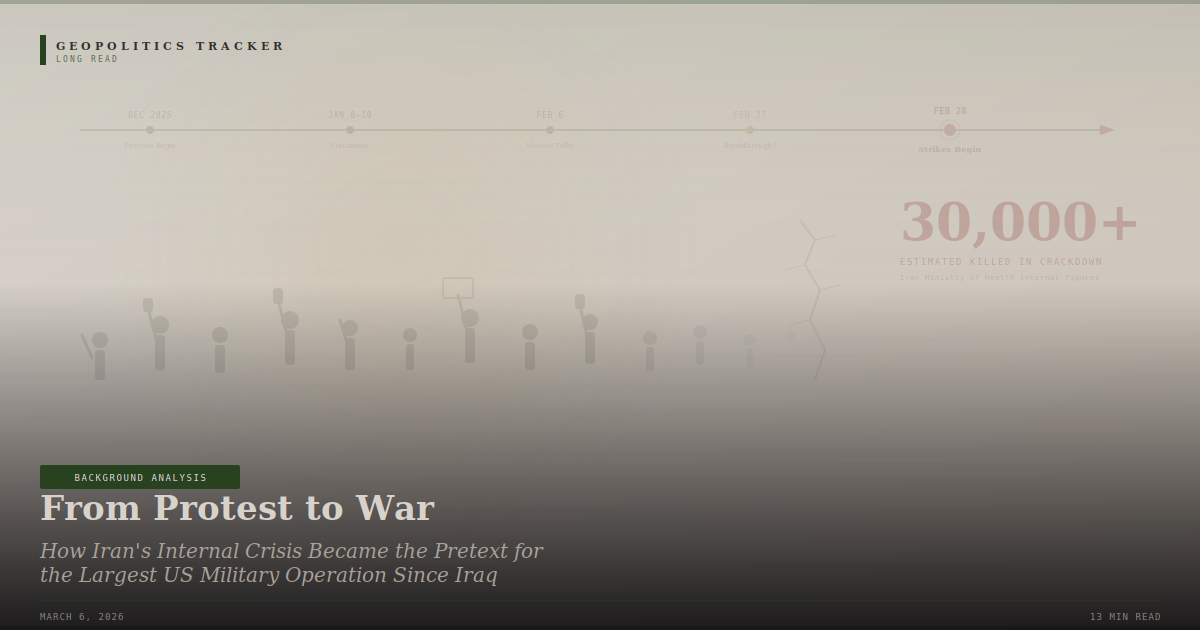
From Protest to War: How Iran's Internal Crisis Became the Pretext for the Largest US Military Operation Since Iraq
Economic collapse, a currency in freefall, the largest protests since 1979, a brutal crackdown killing tens of thousands, and nuclear negotiations that were both succeeding and failing at the same time. The road to February 28 was years in the making.
To understand why the United States launched its most significant military campaign since Iraq, you have to understand what was happening inside Iran in the months before the first bombs fell. The country was not merely a nuclear proliferation concern or a geopolitical adversary. By February 2026, Iran was a nation on the edge of internal collapse — economically shattered, politically fractured, and freshly traumatised by the most violent state crackdown on civilians in its modern history.
This article traces the chain of events from the economic crisis that sparked the protests, through the regime's brutal response, to the diplomatic near-miss that preceded the strikes — drawing on reporting from Encyclopaedia Britannica, the Atlantic Council, the UK House of Commons, and other reputable sources.
The Economic Foundations of Collapse
Iran's economic deterioration was not sudden. It was the accumulated result of decades of sanctions, years of mismanagement, and the compounding damage of military conflicts with Israel in 2024 and 2025. But the tipping point came in late 2025, when the Iranian rial went into freefall. Inflation had already exceeded 40% through much of 2025, but the currency crisis accelerated it dramatically. The collapse of a major Iranian bank in December 2025 forced the central bank to print money, further devaluing the rial and pushing prices beyond the reach of ordinary citizens.
US Treasury Secretary Scott Bessent was remarkably candid about Washington's role in this. In testimony before the Senate Banking Committee in February 2026, Bessent acknowledged that US sanctions policy had deliberately engineered a dollar shortage in Iran, as documented by multiple sources. The explicit goal was to trigger the kind of economic pressure that would destabilise the regime — and by late December 2025, that pressure erupted into the streets.
Iran was simultaneously experiencing a severe water crisis, and reports indicated the government planned to raise taxes at the start of the Iranian new year in March. Meanwhile, President Pezeshkian's proposed budget increased security spending by nearly 150% while offering wage increases amounting to only about two-fifths the rate of inflation, as Britannica documented — a stark illustration of a regime prioritising its own survival over the welfare of its population.
The Protests: Largest Since 1979
The demonstrations began in Tehran on December 28, 2025, and within days had spread to over 100 cities across the country. This was not like the 2022 Mahsa Amini protests, which were driven primarily by women and focused on social freedoms. The 2025–2026 protests were economically motivated at their core, driven by the tangible desperation of people who could no longer afford food and basic necessities. Young men played a larger role than in previous uprisings, and market traders — a group whose mobilisation was instrumental in the 1979 revolution — became influential participants.
Internal estimates from Iran's Ministry of Health indicated at least 30,000 people were killed in the first 48 hours of the government crackdown. This figure, reported by Britannica citing internal sources, would make it one of the deadliest state actions against civilians in the 21st century. The true number remains impossible to verify independently due to Iran's near-total internet shutdown.
Protest slogans shifted ideologically compared to 2022. Some chants increasingly reflected monarchist sentiments, with the exiled crown prince Reza Pahlavi intensifying his political efforts and appealing to the international community. Civilians toppled a monument dedicated to Ayatollah Ruhollah Khomeini. The regime's response was devastating: a crackdown carried out under Khamenei's direct orders for live fire on protesters, resulting in massacres across multiple cities.
The regime also used foreign forces to suppress its own people. According to The Media Line, Iraqi Shia militia members were recruited at $600 each to help suppress protesters. By January 11, more than 60 buses carrying approximately 50 fighters each had crossed the Iraq-Iran border. Witnesses in Kurdish regions reported that security forces did not speak Persian, while in Karaj, an eyewitness said the forces spoke Arabic and photographed themselves with the bodies, as documented from multiple sourced reports.
Trump's Red Line — And What Came After
As the crackdown intensified, Trump threatened to intervene if the Iranian regime continued killing protesters. But when the protests were suppressed without visible fractures within the security establishment, he initially chose not to act. This decision — and its eventual reversal — is central to understanding the rationale behind the February 28 strikes.
The Atlantic Council's expert analysis argued that Trump had set a red line and that, after the regime massacred tens of thousands, his advisers likely argued he had to follow through or risk undermining US credibility — drawing an explicit parallel to Obama's failure to enforce his red line on Syrian chemical weapons. The only remaining question was the scope of targets.
There is a counter-narrative here that deserves attention. Critics, including some within the intelligence community, have pointed out that by the time the strikes were launched, the protests had already been largely suppressed. The moment for intervention to protect protesters had passed. What remained was a regime weakened but still functional — and a set of other justifications (nuclear programme, missile development, proxy networks) that had existed for years without prompting military action of this scale.
The Diplomatic Near-Miss
Perhaps the most contested aspect of the entire chain of events is what happened in the final weeks before the strikes. The UK House of Commons briefing provides a detailed account of this period, and the picture it paints is of two tracks running simultaneously — one toward peace, one toward war.
| Date | Event |
|---|---|
| Feb 6 | Iran and the US held indirect nuclear negotiations in Oman's capital, Muscat. Iran emphasised that progress depended on consultations back in capitals. A second round was scheduled for Geneva. |
| Feb 15–20 | Iran increased its oil exports to three times the normal rate and reduced oil storage — a move that some analysts interpret as preparing for the impact of either a deal or a conflict. |
| Feb 25 | Iran's Foreign Minister Araghchi stated that a historic agreement was within reach ahead of renewed Geneva talks, emphasising diplomacy must be prioritised to avoid escalation. |
| Feb 27 | The IAEA discovered hidden enriched uranium in an undamaged underground facility, saying it could not confirm Iran's programme was exclusively peaceful. Oman's Foreign Minister announced a breakthrough — Iran had agreed to never stockpile bomb-grade uranium and to full IAEA verification. US envoy Witkoff presented a contradictory account, saying Iran had rejected zero enrichment and boasted about its stockpile. |
| Feb 28 | The strikes began. Trump stated the purpose was regime change. |
The gap between Oman's announcement of a breakthrough and Trump's characterisation of failed negotiations remains one of the most debated aspects of the conflict's origins. The UK Commons briefing notes that Oman's Foreign Minister said he was confident a peace deal was within reach, and that Iran had made concessions that were genuinely new. But the strikes came less than 24 hours later.
The Question That Won't Go Away
The Atlantic Council's analysis offers a framework for understanding the broader stakes. It argues that neither protests nor airstrikes alone are likely to end the regime's grip on power. History suggests it requires either the security forces standing aside (as in 1979) or at least part of the security establishment switching sides. The analysis acknowledges that the breadth of economic pain, the water crisis, and the regime's mass killing of protesters make this moment genuinely unique — but cautions that even if the regime does not collapse immediately, this should be viewed as the start of a new era, not another failed attempt at change. After all, the 1979 revolution itself took a full year to unfold.
Something fundamental has changed in Iran. Even if the regime does not collapse immediately, it's critical to remember that the 1979 revolution took a year to unfold. This iteration of protests should be viewed as the start of a new era, not another failure.
— Atlantic Council expert assessment, February 28, 2026
But others see the situation very differently. A weakened Iran does not necessarily become a democratic Iran. As Chatham House argued, a weaker Iran may simply allow greater Chinese influence in the region. Iran's counter-strikes against Gulf states — countries with which it had been building economic relationships — may leave it more isolated than ever, regardless of whether the current regime survives.
The internal picture remains deeply unclear. Internet connectivity has dropped to 4% of normal levels, making independent reporting nearly impossible. Some university students resumed protesting in late February, but whether those demonstrations have grown or been suppressed again is unknown. What is known is that an entire nation that was already in crisis is now also under sustained bombardment — and that the human cost of what comes next will be borne overwhelmingly by ordinary Iranians who had no say in any of it.