Last updated: March 7, 2026
For decades, closing the Strait of Hormuz was the scenario energy analysts described as the single worst thing that could happen to global oil markets. On March 2, 2026, it happened. Not with a naval blockade or underwater mines, but with cheap Iranian drones targeting tankers in a narrow S-curve of water between Oman and Iran — and the cascading withdrawal of insurers, shipping companies, and commercial operators that followed.
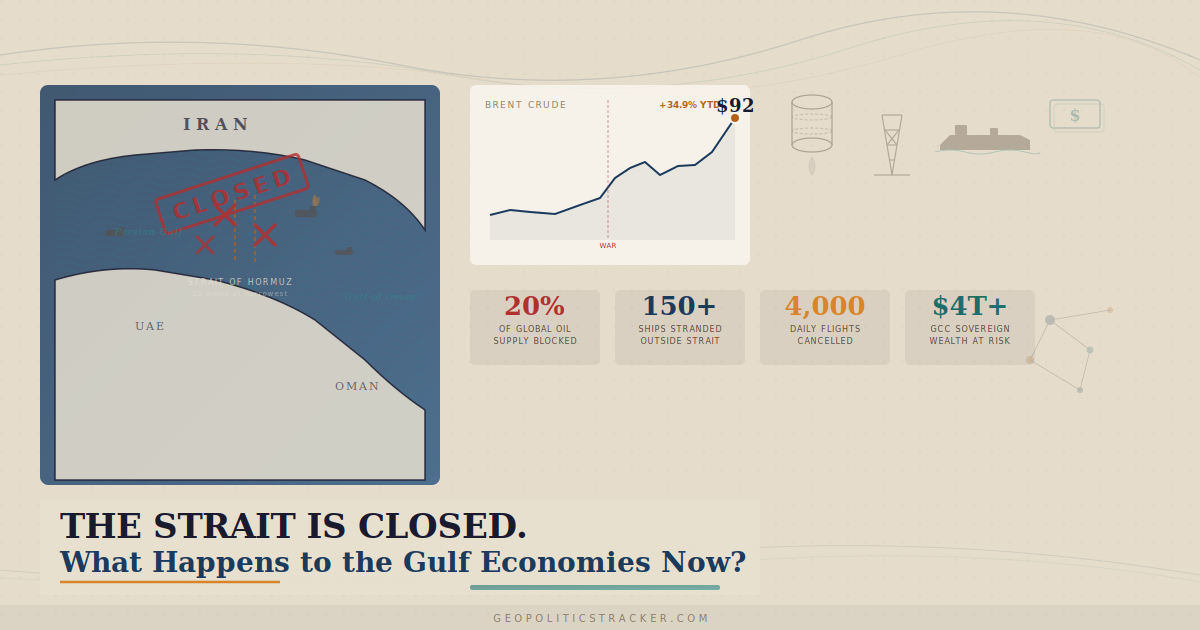
One week into the US-Israel war on Iran, the chokepoint through which 20% of the world's oil and a fifth of its liquefied natural gas normally flows is effectively shut. The consequences for the Arab Gulf economies — which built their entire modern identity on the assumption this would never happen — are already profound.
The Closure: How It Happened
The Strait of Hormuz didn't close with a single order. It died in stages. On the night of February 28, as US and Israeli strikes hit Iran, outgoing traffic through the strait was heavy while incoming traffic was light — a last rush to get through. By March 1, at least three tankers had been struck near the strait, including one off Oman that was set ablaze, killing two Indian crew members. By March 2, no commercial ships were transiting. An IRGC commander officially confirmed the strait was closed, threatening that any vessel attempting passage would be targeted.
The critical insight, noted by Helima Croft of RBC Capital Markets, is that Iran didn't need a navy to close Hormuz. A handful of drone strikes on tankers was enough to make insurers and shipping companies decide the passage was too dangerous. Maersk, CMA CGM, Hapag-Lloyd, and MSC all suspended transits. Over 150 ships dropped anchor outside the strait. Traffic went from roughly 13 million barrels per day to effectively zero.
Kevin Book of Clearview Energy Partners called it the worst single point of failure in global oil markets. Croft went further: this is potentially the biggest energy crisis since the 1970s Arab oil embargo.
Oil Prices: The Numbers
Brent crude has surged dramatically since the war began. Before the conflict, Brent was trading around $67-70 per barrel. As of March 7, Brent futures hit $92.65, with intraday highs touching $94.64 — a gain of over 30% year-to-date. European natural gas prices jumped 24% in early trading on March 2 alone. The week ending March 7 saw crude gain over 16%.
Saul Kavonic, head of energy research at MST Marquee, warned that a sustained closure could produce a crisis three times the severity of the 1970s Arab oil embargo. Analysts at Kpler noted that while some traffic continues — primarily Iranian and Chinese-flagged ships — commercial operators, major oil companies, and insurers have effectively withdrawn from the corridor.
The Gulf States: A Nightmare Scenario Realised
For the six Gulf Cooperation Council (GCC) nations — Saudi Arabia, the UAE, Kuwait, Qatar, Bahrain, and Oman — the Iran war has triggered precisely the scenario they spent decades trying to prevent. As Internationale Politik Quarterly put it, the Gulf states are watching their business model come under enormous pressure: luxury hotels burning in Dubai, airports hit in Kuwait, refineries attacked in Saudi Arabia, and LNG production halted in Qatar.
The damage is profoundly uneven. A detailed analysis by AGBI's lead columnist maps out who's exposed and who has buffers:
Bahrain is the most vulnerable. It entered this crisis with debt at 150% of GDP, a double-digit deficit, and a fragile fiscal reform programme. A neighbouring bailout now looks increasingly plausible. Kuwait has vast sovereign wealth but only about two weeks of oil storage capacity remaining. If Hormuz stays shut, Kuwait will have to stop producing entirely. Qatar has already halted LNG production at Ras Laffan after Iranian drone strikes hit the facility — a devastating blow for a country that supplies around a fifth of the world's LNG.
The UAE, despite having the world's second-largest sovereign wealth fund cluster, has suffered the heaviest reputational and physical damage. Foreign Policy reports that a fire broke out at an Amazon Web Services data center in Dubai after it was struck by shrapnel from an intercepted Iranian drone — possibly the first time in history that a major cloud infrastructure facility was damaged in a war. Over 70% of flights to the UAE, Qatar, and Bahrain remain cancelled. Stock exchanges in the UAE and Kuwait suspended trading.
Beyond Oil: The "Gulf Brand" Under Attack
The economic damage extends far beyond lost barrels. The Gulf states have spent two decades building a brand — Dubai as a global business hub, Doha as a sports and diplomacy capital, Abu Dhabi as an innovation and AI centre. That brand depends on stability, security, and connectivity. All three are now in question.
Consider the cascading effects described across multiple analyses:
Aviation. Dubai International, the world's busiest international airport with over 95 million passengers annually, was effectively shut down after Iranian strikes. Over 4,000 daily flights were cancelled across Gulf airspace, stranding hundreds of thousands of passengers. Emirates suspended operations.
Tourism. Hotel bookings across the Gulf have plummeted. The UAE's tourism industry, which generated $60+ billion in 2025, faces a severe contraction. As Internationale Politik Quarterly observed, the Gulf states define themselves as centres of entertainment and investment — and the images of luxury hotels burning in Dubai and airports under missile fire are devastating to that image.
Financial services. Total commercial bank deposits in the GCC reached $2.3 trillion last year. A significant portion are held by non-residents. Dubai handles 15% of the world's gold trade. The Stimson Center notes that investors are already moving toward safe-haven assets, with gold, the yen, and the Swiss franc all rising.
Trade and logistics. Ports like Jebel Ali and Khor Fakkan are transshipment hubs connecting Europe and Asia. Their paralysis is not just a regional problem — it disrupts global container trade networks.
The Pipeline Lifeline — And Its Limits
Saudi Arabia and the UAE have partial alternatives. Saudi Arabia's East-West Pipeline (Petroline) can move up to 5 million barrels per day to Red Sea ports. The UAE's Habshan-Fujairah pipeline carries 1.5 million barrels per day to a terminal on the Gulf of Oman. Together, these represent about 2.6 million barrels per day of bypass capacity, according to the US Energy Information Administration.
But these numbers are misleading in their optimism. The UAE's Fujairah terminal was itself struck by Iranian attacks. The Saudi pipeline doesn't typically operate at full capacity, and terminal infrastructure at Jeddah limits throughput. Pakistan has already requested Saudi Arabia reroute supplies through its Red Sea port at Yanbu. And even if both pipelines ran at maximum, they would replace less than half the lost flow. As one CBS analyst summarized: there are no meaningful alternatives.
What The Analysts Are Saying
The major financial institutions and think tanks have converged on several key assessments, with notable differences in emphasis:
JPMorgan has cut its non-oil GDP growth forecast for GCC countries by 1.2 percentage points, with the UAE seeing the steepest downgrade. Before the war, their analysts had forecast Brent averaging $60/bbl for 2026 based on soft fundamentals — that forecast is now obsolete.
The Stimson Center warned that a serious Hormuz disruption could remove 8 to 10 million barrels per day from world supply. Hormuz, they concluded, is a transmission belt between regional war and the global economy.
Kpler noted that the conflict is materially improving Russia's competitive position in crude oil markets, with both India and China having strong incentives to deepen reliance on Russian supply as Middle East barrels face logistical disruption.
Nomura identified the most vulnerable Asian importers: Thailand (net oil imports at 4.7% of GDP), South Korea (2.7% of GDP), and India (60% of oil imports from the Middle East).
Reuters reported that three of the four major Gulf states are reviewing previously pledged US investments worth hundreds of billions of dollars, with officials exploring "force majeure" clauses to withdraw or postpone commitments.
The Sovereign Wealth Safety Net
This is what the Gulf's sovereign wealth funds were built for. The Kuwait Investment Authority, created in 1953 and the world's first SWF, proved this concept during Iraq's 1990 invasion, when its London arm effectively became the country's finance ministry. Today, the GCC's combined SWF assets exceed $4 trillion.
But sovereign wealth is not the same as invulnerability. As AGBI noted, if the war drags on and higher prices fail to offset the revenue hit from the transit blockage, expect a wave of simultaneous debt issuance from Saudi Arabia, Kuwait, Bahrain, and Qatar. And if military escalations continue and domestic demands grow, global investment portfolios may be paused — with priority shifting to citizen security and supply chain resilience.
The geopolitical knock-on is already visible: Seoul Economic Daily reports that global companies based in the UAE are considering relocating to Saudi Arabia, which has overland export routes and has suffered comparatively less physical damage.
The Deeper Question: Was the Gulf Model Ever Sustainable?
There's a less discussed dimension of this crisis that AGBI's analysis surfaces powerfully: the continued hydrocarbon dependence of the Gulf's non-oil economy. Even the "diversified" sectors — aluminium smelting, petrochemicals, data centres, desalination, air conditioning — all run on gas. If oil production halts because there's nowhere to export it, associated gas production halts too. The lights don't just dim on the export ledger — they dim domestically.
The Gulf states are not friends of Iran. They fear the chaos and anarchy that could accompany regime change in Tehran, which is precisely why they spent years pursuing de-escalation, normalization, and back-channel diplomacy. Saudi Arabia and Iran resumed diplomatic relations in 2023. Qatar shares a gas field with Iran. Oman served as a mediator. All of that framework has been destroyed in a week.
What to Watch
- Insurance markets. Shipping won't resume until insurers return. The US government's offer of DFC-backed insurance and naval escorts has been met with skepticism from the shipping industry. As one Greek shipping CEO told NPR, the priority is not just moving cargo but protecting the lives of seafarers.
- OPEC+ response. Eight OPEC+ members announced production increases on March 1, but this is largely symbolic — you can't export oil that's trapped behind a closed strait.
- Saudi pipeline throughput. Whether Riyadh can meaningfully scale up East-West Pipeline flows to Yanbu will determine how much of the world's supply gap can be closed.
- Qatar LNG restart. Ras Laffan was halted after Iranian strikes. Every day it stays offline tightens Asian LNG markets and raises European gas prices.
- Gulf SWF drawdowns. Watch for any sovereign debt issuance or investment pauses from Riyadh, Abu Dhabi, Doha, or Kuwait City. Abu Dhabi's recent bond issuance at near-record-tight spreads now looks prescient.
- Duration of conflict. As S&P Global's Jim Burkhard noted: an extended closure would be "epochal for the oil market" with prices rising to ration scarce supply.
The Bottom Line
The Strait of Hormuz crisis has exposed a fundamental vulnerability: the entire modern Gulf economy — its airports, its tourism, its financial centres, its real estate, its Vision 2030 ambitions — was built on the assumption that this chokepoint would never be closed. That assumption has been invalidated in a week by weapons that cost a fraction of what a single tanker is worth.
Higher oil prices should, in theory, be good for Gulf producers. But you can't sell oil you can't ship. The cruel paradox of this crisis is that oil is simultaneously more valuable and less accessible than at any point since the 1970s. The Gulf states now face a period where their revenues are frozen, their infrastructure is under fire, their brands are damaged, and their decades of careful regional diplomacy with Iran have been undone by an American and Israeli war they did not choose and cannot control.
The sovereign wealth funds provide a buffer. But no fund is large enough to insure against a permanent rearrangement of the region's security architecture. The question is no longer whether the Gulf model works in peacetime — it's whether it survives a war that nobody in Riyadh, Abu Dhabi, or Doha wanted.
This analysis synthesizes reporting and data from NPR, CNBC, Foreign Policy, AGBI, Internationale Politik Quarterly, Stimson Center, Kpler, US EIA, Al Jazeera, CBS News, Janes, Reuters via Investing.com, JPMorgan, Seoul Economic Daily, and OilPrice.com. All opinions are attributed to their respective sources.