Europe is heading to Beijing with two demands that pull in different directions: buy more of what we make, and keep supplying the materials we need to make it.
Trade commissioner Maroš Šefčovič and China’s commerce minister, Wang Wentao, are scheduled to meet on 8–9 October. Brussels has put market access, Chinese exports and rare-earth controls on the agenda. This week’s talks will test whether a bargain can protect European factories without making their inputs harder to obtain. [1] [6]
That distinction matters. A purchase agreement could improve the trade figures while leaving a production bottleneck untouched. Faster export licences could keep assembly lines running without giving European suppliers a fairer opening in China. A useful deal would have to address both.
The gap is large. It is also an incomplete diagnosis.
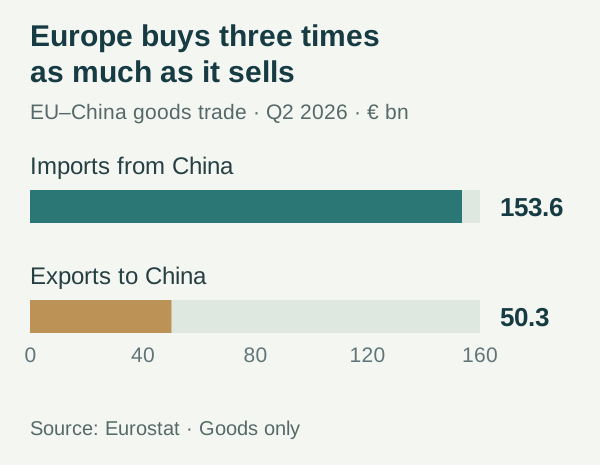
In the second quarter of 2026, the EU imported €153.6 billion in goods from China and exported €50.3 billion there, according to Eurostat. That leaves a €103.3 billion goods deficit, calculated from the published figures. China supplied 21.9% of the bloc’s imports from outside the EU but took 7.4% of its exports to those markets. [2]
The gap widened even though European exports to China grew 2.8% from a year earlier: imports from China rose 7.9%. Europe is therefore negotiating over a relationship that is still expanding, rather than one already coming apart. [2]
View chart data
| Measure | € billion |
|---|---|
| Imports from China | 153.6 |
| Exports to China | 50.3 |
But a bilateral deficit is a balance of purchases and sales, not a bill for economic damage. Cheaper imports can help consumers and firms using Chinese components. The balance also says little about whether a particular imported part can be replaced. Reducing imports indiscriminately could shrink the deficit while raising costs for Europe’s own manufacturers.
The industrial pressure is nevertheless visible beneath the total. Eurostat’s first-half comparison shows EU exports to China of machinery and mechanical parts fell by €2.8 billion from a year earlier; vehicle and parts exports fell by €2.5 billion. Pharmaceuticals rose by €2.1 billion. Different industries have different problems, which makes a single headline purchase target a poor substitute for changes in market access. [3]
A small component can outweigh a large market
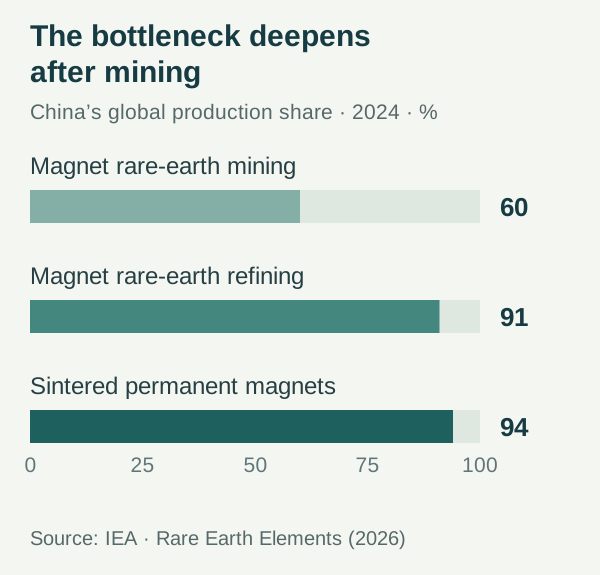
Rare-earth magnets expose the other side of Europe’s negotiating position. The International Energy Agency puts China’s 2024 share of magnet rare-earth mining at 60%, refining at 91%, and sintered permanent-magnet production at 94%. These are global production shares, not Europe’s import dependence; they show how sharply the supply chain narrows after extraction. [4]
View chart data
| Measure | % of global production |
|---|---|
| Magnet rare-earth mining | 60 |
| Magnet rare-earth refining | 91 |
| Sintered permanent magnets | 94 |
This is why a new mine alone cannot solve the problem. Manufacturers need usable material and finished magnets, not simply access to ore. In 2025, licensing disruptions following China’s April controls forced some automakers to reduce output or temporarily stop production, the IEA reports. Shipments subsequently recovered as licences were issued. [4]
For a factory, the relevant calculation is not the magnet’s share of the final product’s price. It is the cost of being unable to finish that product. If a substitute cannot be qualified in time, a cheap missing component can interrupt an expensive assembly line. That gives the supplier influence which the total value of trade fails to capture.
What Beijing can offer—and what Europe should count
China’s stated approach leaves room for a deal. After June’s first round of consultations, its commerce ministry emphasised expanding commerce, including services and green industries, and resolving access concerns through negotiation. It also offered platforms to help European companies sell in China. That is a position to test against delivery, not evidence that barriers have already been removed. [5]
For Beijing, additional European purchases could preserve access to an important export market without requiring a wholesale retreat from its industrial strategy. For Brussels, a targeted agreement could deliver relief sooner than a broad confrontation. These incentives favour a limited bargain; they do not establish that one will be reached.
There is a serious case for accepting something narrow. A manufacturer facing uncertain deliveries may value predictable licensing more than a sweeping promise of future rebalancing. The weakness is durability: temporary relief can leave companies facing the same uncertainty at the next dispute. European policymakers would need to distinguish time bought for diversification from dependence simply extended.
Three details will make the outcome legible. On market access, look for named restrictions removed, effective dates and eligible suppliers—not just a promised purchase total. On minerals, look for the products covered and the duration and predictability of licensing arrangements. On enforcement, look for a process that identifies breaches and specifies what happens next.
The clearest evidence will come after the meeting: shipments clearing, orders delivered and firms able to use the new rules. If the result is another working group, the underlying exposure remains. If access becomes more dependable, even a modest agreement could matter. Europe’s objective should be a factory that can sell more abroad and keep producing when diplomacy turns sour.
Sources and data notes
Research checked on 6 October 2026, before the scheduled talks. Outcomes remain unknown. Official statements establish the parties’ positions; the assessment of their bargaining incentives is GT Team’s analysis. Trade figures use Eurostat’s August releases and may later be revised. Imports are valued including cost, insurance and freight; exports are valued free on board. The rare-earth chart uses 2024 production data.
- China trade briefing — European Commission, 2026-09-18.
- Top trade in goods partners in Q2 2026: US and China — Eurostat, 2026-08-26.
- EU trade with China: latest developments — Eurostat, 2026-08-25.
- Rare Earth Elements: executive summary — International Energy Agency, 2026.
- Readout of the first China–EU Trade and Investment Consultations — China Ministry of Commerce, 2026-07-02.
- This week: EU trade chief heads to China — EUobserver, 2026-10-05.