Financial support can help Gulf households and businesses survive disrupted trade. Recovery also requires ships to move goods and refineries to supply usable fuel. The IMF’s October 1 forecast makes shipping a condition of a strong 2027 rebound. The implication is that financial strength and physical capacity must be assessed together: rerouting and diversification help, while lasting recovery also depends on firms being able to deliver goods, manage costs and earn income again.
The condition behind the IMF’s recovery forecast
On October 1, the International Monetary Fund (IMF) forecast that the Gulf Cooperation Council (GCC) economy would contract in 2026, followed by a strong recovery in 2027 if shipping gradually returns to normal. The condition matters as much as the rebound. The IMF gave no numerical contraction estimate, and its regional forecast does not establish an outcome for every member country. Updated World Economic Outlook forecasts were still forthcoming. A Saudi GDP figure raised by a questioner at the separate IMF briefing was not the Fund’s forecast. [1] [2]
For a business, receiving financial support and being able to fulfil an order solve different problems. Public spending may help firms stay open and households keep buying during a disruption. Yet production and sales can still suffer when essential supplies or export routes are unavailable. This suggests that the recovery test should include both financial endurance and delivery capacity. Policymakers need to watch whether firms can move goods and restore activity, alongside how long public support can sustain incomes. The IMF’s conditional rebound gives a reason to track both. [1] [2]
How shipping problems reach the wider economy
The International Energy Agency’s (IEA) September 11 public report estimated August Gulf oil exports at roughly half their pre-war level. It also described tight refined-product markets, estimated global oil inventory drawdowns since February at 507 million barrels, and deferred a full Gulf supply recovery to 2027. Its forecast for 2026 oil demand was lower. These figures describe earlier observations and September forecasts. They are not fresh October measurements; this analysis uses the accessible public highlights rather than the paywalled full report. [3]
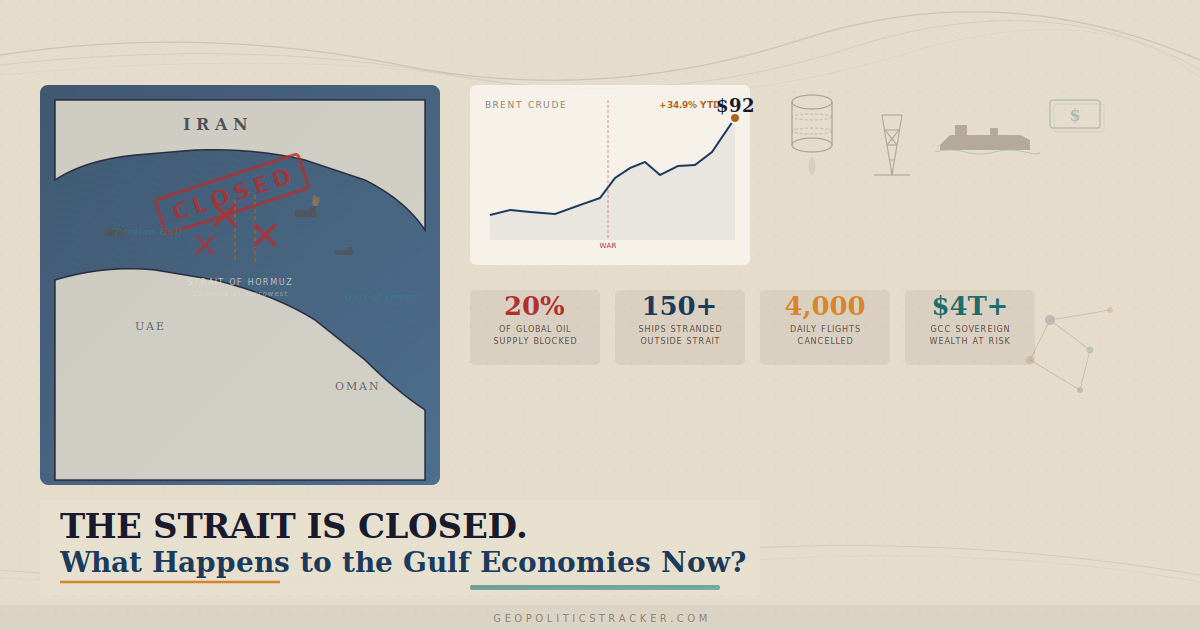
The economic pressure can travel well beyond an oil terminal. Restricted shipping may reduce the volume of exports delivered, limiting income even when prices rise. Costly freight and scarce refined fuels can also raise the operating costs of businesses outside the oil sector. The IMF’s October briefing said inflation had stopped easing in some countries and linked higher bond yields partly to energy-driven changes in expectations for monetary policy. Together, these channels suggest that expensive energy can make recovery harder to finance. The briefing did not quantify that effect for individual Gulf economies, so the mechanism should not be read as a country-specific borrowing forecast. [1] [2] [3]
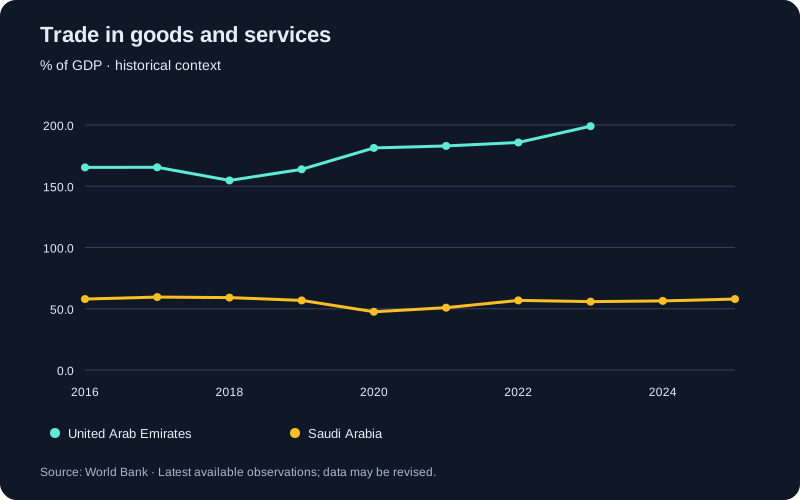
Historical context, not a measure of today’s events. World Bank dataset · Retrieved 2026-10-03 · Download chart data (CSV)
Accessible chart data
| Country | Year | Value |
|---|---|---|
| United Arab Emirates | 2016 | 165.39 |
| United Arab Emirates | 2017 | 165.48 |
| United Arab Emirates | 2018 | 154.75 |
| United Arab Emirates | 2019 | 163.82 |
| United Arab Emirates | 2020 | 181.29 |
| United Arab Emirates | 2021 | 182.91 |
| United Arab Emirates | 2022 | 185.74 |
| United Arab Emirates | 2023 | 199.04 |
| Saudi Arabia | 2016 | 57.92 |
| Saudi Arabia | 2017 | 59.53 |
| Saudi Arabia | 2018 | 59.10 |
| Saudi Arabia | 2019 | 56.79 |
| Saudi Arabia | 2020 | 47.53 |
| Saudi Arabia | 2021 | 50.88 |
| Saudi Arabia | 2022 | 56.82 |
| Saudi Arabia | 2023 | 55.80 |
| Saudi Arabia | 2024 | 56.40 |
| Saudi Arabia | 2025 | 57.92 |
Bypass routes buy breathing room
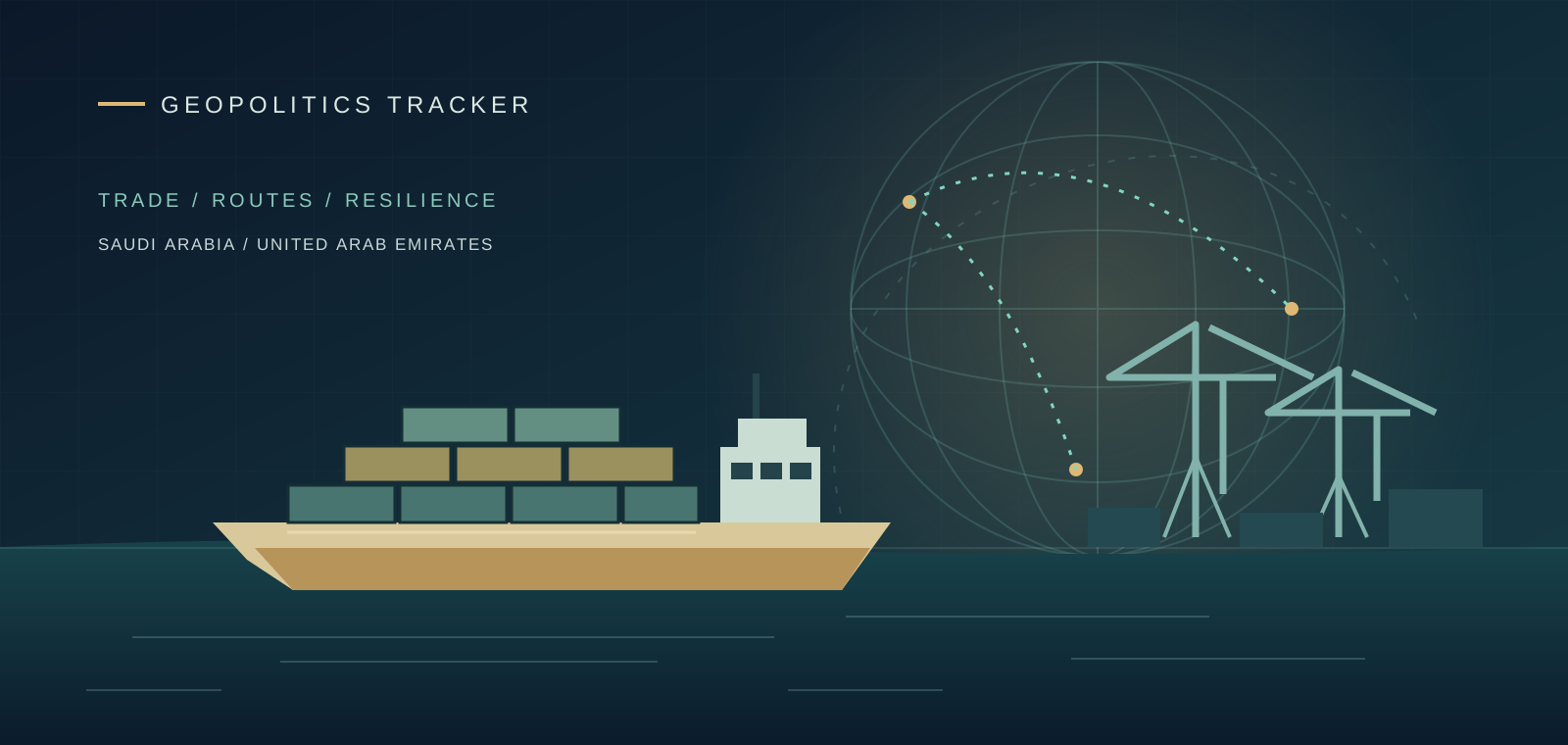
The IEA’s September 18 commentary reported that Saudi and UAE exports through ports bypassing Hormuz rose between February and June, then fell in August amid renewed regional insecurity. The August observations were provisional and partly based on Kpler data. The commentary also reported an early-September interruption of Saudi Arabia’s East-West pipeline. That dated observation does not establish the pipeline’s status on October 3. Even with supply adjustments, the IEA described continued inventory depletion and a remaining market deficit. [4]
A bypass route matters when it carries dependable shipments. Its capacity on paper is only part of the story. The changing flows described by the IEA suggest that alternative routes provide options whose reliability still needs to be tested. Inventories work differently: stored supplies can bridge an interruption, but stocks cannot keep falling indefinitely without replenishment. Financial buffers may fund adjustments and help firms absorb losses. The practical challenge is to use that breathing room to improve delivery conditions while businesses remain viable. Lasting resilience should show up in steadier flows and less reliance on drawing down stocks. [1] [3] [4]
The strongest case for a smoother recovery
There is a substantial case for a smoother recovery. The IMF credited diversification with softening the blow in Bahrain, Saudi Arabia and the UAE. Its October briefing linked Saudi resilience to rerouting, infrastructure, macroeconomic fundamentals, fiscal support and private consumption. The IEA also described higher non-Gulf supply, rerouting and lower demand offsetting part of the disruption. Its analysis distinguished large losses in headline flows from the smaller market deficit that remained after these adjustments. The offsets are material to any assessment of the shock. [1] [2] [4]
The more optimistic interpretation is that existing adjustments and financial support may protect incomes until normal activity resumes. If that proves right, the physical constraints could be less lasting than this article’s central concern suggests. A smaller supply deficit, however, can reflect both improved availability and consumption suppressed by high prices or shortages. The IEA’s lower demand forecast makes that distinction worth watching. A convincing recovery would combine better supplies with stronger activity. Easier market balance achieved while firms and consumers cut back would tell a less reassuring story, even if immediate pressure on supply had eased. [1] [3] [4]
Support businesses through the bottleneck
Policy support works best when it addresses the constraint a business actually faces. The IMF recommends temporary, targeted assistance and cautions against broad stimulus where weaker activity mainly reflects disrupted supply. One implication is to help viable firms survive while delivery conditions improve. Extra spending could otherwise raise demand for goods that remain scarce. Diversification also needs careful interpretation: a business outside the oil sector may still face expensive fuel, freight or finance. Support could be linked to those operating pressures, with withdrawal guided by evidence that conditions have improved. An encouraging aggregate indicator alone would provide only part of that evidence. [1] [2]
What would change this outlook
Forecasts depend on assumptions that need to be revisited. A June 11 World Bank commentary described a baseline in which acute disruption eased in July and Hormuz shipping largely recovered by late 2026. Its energy-stress scenario considered a later reopening and reduced supply capacity. These were June assumptions, not evidence that the expected recovery happened or a new October forecast. The sources also overlap: two documents come from the IMF and two from the IEA. Five documents therefore represent three institutional origins, rather than five independent confirmations. [1] [2] [3] [4] [5]
The clearest test is whether shipping and usable fuel supplies improve together with stable inventories and recovering demand. Sustained progress across those measures would weaken the concern that financial support is mainly cushioning persistent physical constraints. Crude flows recovering while refined fuels remain scarce would leave a different picture, with transport improving before businesses get relief from fuel costs. Fresh, comparable observations should carry more weight than repeated statements from the same institution. The evidence supports watching these conditions closely; it does not establish the depth of contraction, the outcome for each country or a guaranteed recovery date. [1] [2] [3] [4]
Scenarios and signals to watch
Conditional possibilities, not predictions or assigned probabilities.
Shipping and fuel supplies recover together
If Shipping gradually normalizes and refined-product supply improves without continued inventory depletion.
Then The IMF’s conditional 2027 recovery becomes more plausible, and financial support can bridge a diminishing interruption rather than compensate for persistent physical shortages.
Watch Successive observations show stronger delivered exports, easing product scarcity and stable inventories alongside recovering consumption. [1] [3] [4]
Shipping improves, fuel constraints persist
If Transport flows recover while refined-product capacity and availability remain restricted.
Then Export income could improve before non-oil operating costs ease. Fuel inflation could continue complicating monetary expectations and borrowing conditions, leaving recovery uneven rather than automatic.
Watch Shipping and export volumes improve, but product shortages persist and inflation or financing conditions fail to ease correspondingly. [1] [2] [3]
Supply pressure eases as demand weakens
If Rerouting and outside supply narrow the deficit, but consumption remains depressed and inventories continue falling.
Then Market pressure could moderate without a broad economic recovery. Financial buffers would still be cushioning lost activity rather than demonstrating that physical resilience had fully restored it.
Watch Smaller reported supply deficits coincide with weak consumption and further inventory draws instead of sustained growth in available supply. [1] [3] [4]
Sources and methodology
Primary statements establish what institutions said; they do not independently establish disputed facts. Reporting is checked for shared origins. The chart is generated directly from the linked dataset; missing observations are not zero. The source list is a research trail, not a guarantee of accuracy.
- Managing Director's Remarks at the Meeting of the Ministers of Finance and Central Bank Governors of the Gulf Cooperation Council — International Monetary Fund, 2026-10-01 (primary)
- Press Briefing Transcript: Julie Kozack, Director, Communications Department, October 1, 2026 — International Monetary Fund, 2026-10-01 (primary)
- Oil Market Report - September 2026 — International Energy Agency, 2026-09-11 (primary)
- Oil markets strain to plug the gap left by Middle East supply shortfall — International Energy Agency, 2026-09-18 (primary)
- The global economy in five charts — World Bank, 2026-06-11 (primary)